
https://www.aconfront.com/the-ultimate-guide-to-kitchen-lighting-design-from-plan-to-perfection/
In kitchen renovations, I often see a heartbreaking scene:
People are willing to spend 20,000 to 30,000 yuan on a top-of-the-line steam oven, a large-capacity French refrigerator, or even a professional-grade semi-automatic espresso machine—but when it comes to lighting budgets, they suddenly switch to “frugality mode.” They install a regular ceiling light or just throw together a few bright spotlights, and the renovation is quickly finished.
As a result, on the first day of check-in, regret immediately overwhelmed me:
Two glaring white spots of light were reflected on the black crystal glass oven panel, making it look like two scratches.
The brushed stainless steel refrigerator is full of reflections and shadows, and the fingerprints are so clear that it looks like a “detective scene”.
You bought a high-end blender, but because the control panel is backlit, you can’t even see the numerical markings…
The true quality of a kitchen is never about how much the refrigerator costs or how professional the coffee machine is, but rather whether the lighting complements them.
Good lighting can make a $2,000 refrigerator look like it costs $20,000;
while bad lighting can turn top-of-the-line kitchen appliances into “light pollution disaster areas”.
Lighting design can’t be based on imagination.
Before the plumbing and electrical work begins, you need to figure out the key points for the layout of kitchen appliances and the selection of panel materials .
Determining whether appliances are glass or metal, built-in or countertop-mounted, will help avoid problems like reflections, shadows, and glare.
This time, we’ll debunk the most common lighting mistakes in the kitchen that can easily ruin the appearance of your appliances.
I. Reflective Disasters: Lighting Taboos for Glass and Stainless Steel Panels
The two most favored materials for high-end kitchen appliances are
brushed stainless steel and black glass .
They are undeniably elegant, but they are also undeniably reflective.
1. Avoid direct sunlight angles to prevent kitchen appliances from being “blinding” your eyes.
Many people like to install a row of spotlights above their kitchen cabinets, thinking that “illuminating the cabinet doors will give them a more upscale feel.”
However, if the light is too close (less than 15cm) or shines directly on the refrigerator door, it’s the beginning of a glare nightmare:
blinding glare
Fine lines and water stains on the surface of electrical appliances are magnified infinitely.
The white spots on the black crystal glass looked so abrupt, like two band-aids.
✔ Correct lighting method:
To avoid illuminating objects while washing the wall,
hold the spotlight 25cm–30cm away from the wall, allowing the light to “slide down” along the wall surface to reduce mirror reflections.
Avoid using glossy, shallow-cup “cheap light” from
deep-cup anti-glare spotlights .
Deep-cup anti-glare spotlights can make the light source invisible, leaving only a soft, non-glaring light spot, making the metal look “matte and noble”.
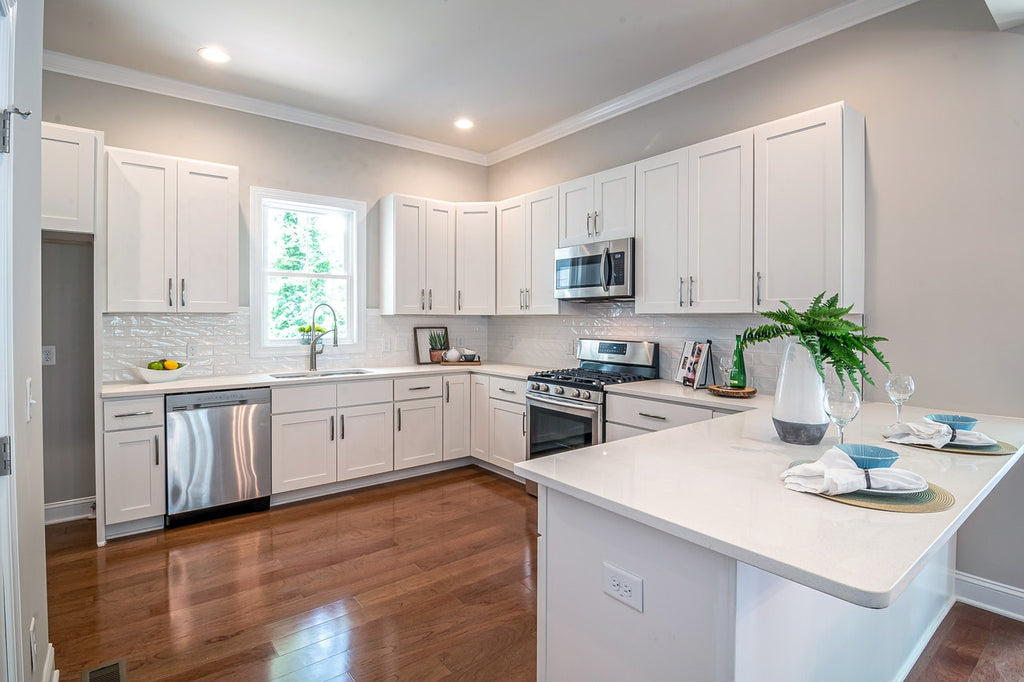
2. Blind Spots in Operation: Small Appliances on the Countertop Need “Supplemental Lighting”
Besides built-in appliances, kitchens also have countertop “regulars” like coffee machines, blenders, and air fryers.
These are usually located under the wall cabinets—the area most easily blocked from light.
1. Your body is the biggest “sunshade” for the control panel.
If you rely solely on the main kitchen light, your body will block the overhead light when you stand at the counter.
This will turn the entire work area into shadow.
The pointer is hard to see when adjusting the coffee machine’s extraction pressure.
Adjusting the speed of a high-speed blender requires bending over and “probing” the device.
Hand shadows and utensil shadows flew everywhere while cooking.
✔ Correct approach: Install under-cabinet lights
Under-cabinet Lighting = Kitchen Lifesaver
Install a hand-swipe sensor light strip or ultra-thin light strip at the bottom of the wall cabinets to illuminate the entire countertop. This step is a must-do in all professional kitchens.
Color temperature selected: 4000K (neutral light)
While 3000K is a warm color, it can cause color distortion when reading scales or observing the state of liquids.
4000K light is closest to natural light, making it suitable for operating precision electrical appliances and accurately reflecting the colors of food.
III. Atmosphere Creation: Turn Your Stylish Home Appliances into “Display Items”
If you have a SMEG vintage refrigerator, a La Marzocco coffee machine, or any art-grade kitchen appliance in your home, it deserves to be highlighted, not buried in the shadows.
Accent lighting
Avoid using a wide-area light source.
Instead, give it its own dedicated “spotlight”.
Narrow beam spotlights (15°–24°)
focus light onto appliance surfaces, much like a museum treats its exhibits.
A stronger sense of three-dimensionality
The nameplate and body lines are clearer.
To truly make the kitchen “amazing from the moment you step inside”.
This is the standard lighting logic for luxury kitchens:
not to make the kitchen brighter, but to make what you want people to see brighter.
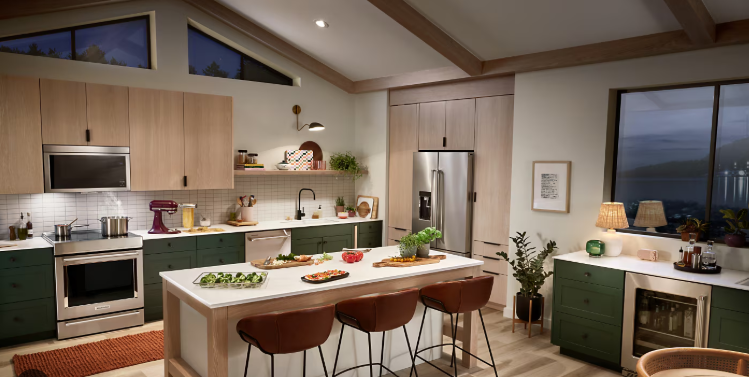
IV. The “Invisible” Aesthetics of Built-in Home Appliances: Light Makes Flatness Even Flatter
The core appeal of a fully integrated kitchen lies in the seamless integration of appliances and cabinetry.
Lighting can further enhance this sense of smoothness.
Linear lighting: Making a space look “effortlessly expensive”
Add recessed linear light strips around the tall cabinet of the steam oven so that the light outlines the boundary like thin lines:
The size of the home appliance market has been weakened.
The cabinet has a cleaner silhouette.
The sense of technology in the space has been greatly enhanced.
Especially the baseboard lights, when turned on at night, give the entire kitchen a “floating, light feeling”.
Conclusion
Light is the most easily overlooked yet most crucial element of kitchen interior design.
When buying kitchen appliances and designing lighting, don’t think about them separately.
A truly high-end kitchen is one where light gently glides over the metal surfaces of the appliances, without glaring reflections or shadows, and every appliance is treated with care.
Before you place your order for that expensive refrigerator, ask yourself:
Have I prepared light that truly matches it?
https://www.aconfront.com/the-ultimate-guide-to-kitchen-lighting-design-from-plan-to-perfection/