
https://www.aconfront.com/the-ultimate-guide-to-mastering-home-lighting-design/
Many people’s first reaction is: Shouldn’t chandeliers be installed in large living rooms or spacious areas? Won’t they make small apartments feel cramped?
But actually, small spaces can absolutely accommodate chandeliers , and often the effect is even more surprising. Choosing the right size and style can be like dressing up a room with an “eye-catching accessory,” enhancing both lighting and design, adding a touch of ritual to daily life.
However, pendant lights for small spaces are indeed quite “picky.” If details like size, style, material, and installation height aren’t handled correctly, the pendant light can become a visual burden. Therefore, choosing a pendant light is both a science and a matter of skill. Today, I’ll share some tips on pendant lights and home spaces , allowing you to select the right pendant light for spaces of different sizes.
II. Determining the Dimensions: A Simple Formula Is Enough
Many people fail when choosing a chandelier, and the problem is often not whether it looks good or not, but rather— buying one that’s too big or too small . Proportion is especially important in small spaces.
Designers often use a basic formula to estimate the diameter of a chandelier:
Room length (ft) + room width (ft) ≈ chandelier diameter (inch)
For example, a 10′ × 12′ room with a diameter of approximately 22″ (about 56 cm) is generally quite suitable.
This method is recognized by many lighting organizations, including the American Lighting Association, so it is actually quite reliable.
If you are mounting it on a dining table or island, the proportions can be adjusted slightly:
The width of the chandelier is approximately 50%–66% of the tabletop width.
Never let the chandelier be wider than the table, otherwise it will look strange.
If the dining table is long and narrow, a **linear chandelier** would be more harmonious; the width of each chandelier should be approximately 1/4–1/3 of the table’s length.
You’ll love these kinds of “little formulas” after just one use.
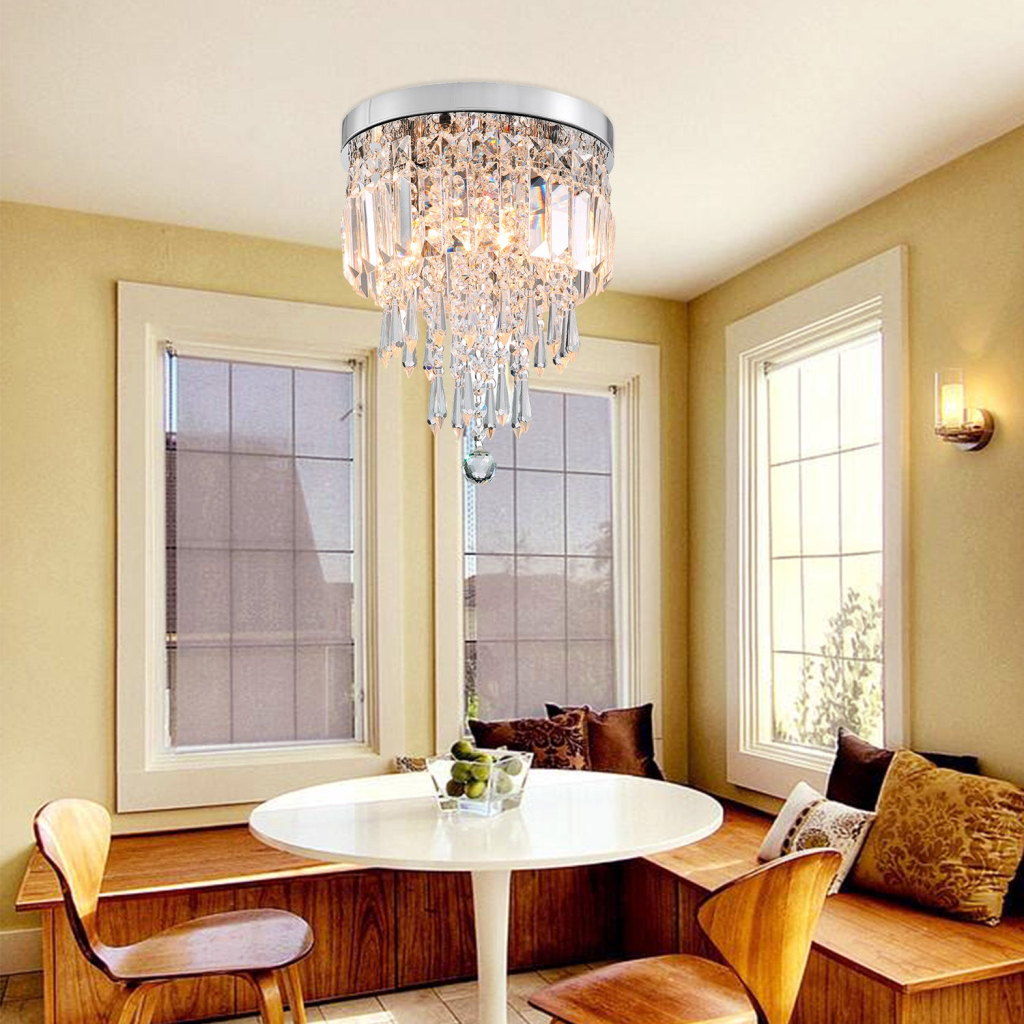
III. How to choose the height of a chandelier? Avoid causing people to bump their heads.
Once the dimensions are settled, the next important thing is the hanging height. Hanging it too low will make it feel cramped, while hanging it too high will make it feel invisible—this is especially important in small spaces.
Standard floor height (approximately 8 ft / 2.4 m):
7 feet (≈ 2.1 m) above the ground .
For dining tables → bottom of table should be 30–36 inches (76–91 cm) from the tabletop.
High-rise
For every additional 1 ft (30cm) of ceiling height, the chandelier can be lowered by approximately 3 inches for better proportions.
For low ceilings (common in small rooms) , try this:
semi-flush ceiling light
Flushed mount ceiling
lights are closer to the ceiling, saving vertical space and preventing the space from feeling cramped.
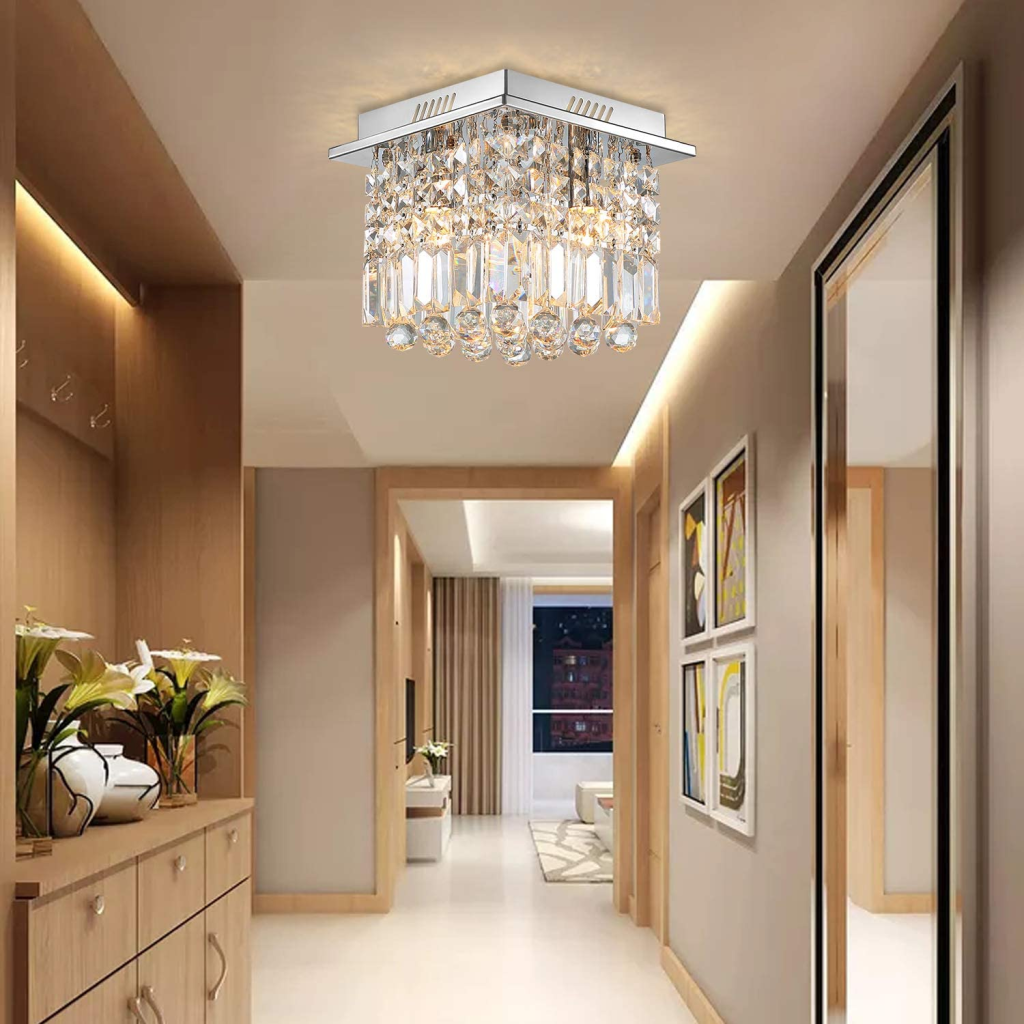
4. Choose a light and airy style: Let your small space “breathe”.
In small spaces, the design of a chandelier is not something to be chosen arbitrarily. The heavier and denser the light fixture, the more likely it is to make you feel oppressed.
These styles are especially suitable for pendant lights in small apartments:
Transparent materials : glass, crystal, acrylic → diffuse light and reduce visual weight
Open structure : metal wireframe, geometric shapes, globe-like structure → stronger sense of airiness
Mini linear pendant lights : especially suitable for narrow spaces
Fabric drum-shaped lampshade : Soft, gentle light suitable for bedrooms or reading nooks; lighter colors are more comfortable.
What these materials have in common is that they are more transparent and lighter, making the space look more “relaxed”.
V. Brightness and Color Temperature: The Magic of Creating Atmosphere in Small Spaces
Small spaces are more sensitive to light than large spaces. If the light is too bright, too white, or too harsh, it can easily make the space feel cramped.
Brightness (lumens) reference:
Small living room/dining room: 20–30 lumens per square foot
Bedroom: 10–20 lumens per square foot (softer is better)
Color temperature (Kelvin)
Looking for comfort and warmth? 2700K–3000K
Want a cleaner, more modern look? Choose the 3000–3500K.
Color Rendering Index (CRI)
LEDs with a CRI ≥ 90 → produce more natural colors, making fabrics and accessories look more “realistic”.
The dimming function
is a lifesaver for small spaces. It allows you to adjust the lighting atmosphere at any time, making it brighter during the day and dimmer at night, all with a simple turn of the switch.
VI. Style Matching: Chandeliers are “decorative” elements of a space.
When choosing a chandelier, many people focus on the light itself, forgetting that it should blend into the overall space. In fact, lighting, like furniture, is an important part of style.
Modern minimalism : metallic lines, geometric shapes, and small Sputnik shoes are very versatile.
Nordic style : wood and metal, lightweight structure, gentle and tranquil.
Bohemian/Country Style : Wickerwork, beads, wooden beads, light and natural.
Luxury Crystal : As long as the size isn’t excessive, small crystal chandeliers can look great in small spaces.
Tip:
Match the metallic tone of the chandelier with door handles, table legs, picture frames, kitchen handles, etc., and the overall look will suddenly become very unified.
7. Chandeliers alone are far from enough (layered lighting is crucial).
The problem with many small spaces isn’t that the lights aren’t bright enough, but rather that the light source is too singular .
Professional designers emphasize layered lighting:
Ambient : The chandelier provides overall lighting (background).
Accent : Wall lamps, floor lamps, decorative lamps, responsible for “lighting up” the atmosphere.
Task : Reading light, kitchen countertop light, responsible for practical functions.
When these three elements are combined, the space will have a sense of “depth” and will not feel cramped.
8. Installation and Maintenance: Attention to Detail is Even More Important in Small Spaces
It is recommended to hire a professional electrician for installation to ensure the load-bearing capacity and the safety of the wiring.
Pendant lights in small spaces tend to get dirty easily → Regular dusting is recommended.
When changing light bulbs, prioritize LEDs; they have a longer lifespan and are easier to use.
If you can’t find the right size, consider niche brands or custom-made items, which are often more precise and have a better design.
9. Common Misconceptions When Buying Chandeliers for Small Spaces
These are the pitfalls users are most likely to fall into:
Buying the wrong size chandelier (especially one that’s too small) is a common mistake.
Many people on Reddit say that “buying a larger one will look better,” and that’s actually true.
Without a dimmer switch
, the lighting will remain unchanged, making it difficult to adjust the atmosphere.
Ignoring the
low ceiling height and buying a long pendant light → the space is instantly compressed.
The most common problem is that people only look at the appearance and ignore the lighting effects . They think the lights look nice, but they are not practical.
Conclusion
choosing a pendant light suitable for a small space is actually:
Use the formula “room length + width” to secure the dimensions.
The hanging method should be determined based on the ceiling height (semi-flush is recommended for lower ceilings).
Choose a design that is lightweight, transparent, and has a strong sense of openness.
Brightness, color temperature, and dimming all need to be considered.
Let the chandelier blend in with the overall style
Implement layered lighting; don’t rely on chandeliers for “all the light.”
Finally, pay attention to installation and maintenance.
When all these things are done, the chandelier will not only not “crush” the space, but will also bring a delicate, warm, and even slightly sophisticated atmosphere to the small room.
https://www.aconfront.com/the-ultimate-guide-to-mastering-home-lighting-design/