
https://www.aconfront.com/the-ultimate-guide-to-mastering-home-lighting-design/
With modern living spaces becoming increasingly compact, making small spaces appear more spacious and sophisticated has become a challenge for many homeowners during renovations. Among various design techniques, recessed lighting (also known as downlights or recessed lights) has become a top choice for many designers due to its simplicity, ceiling-mounted design, and space-saving nature.
It can make ceilings cleaner, light softer, and visually more expansive , and it’s also a good space management technique . This article will guide you through five aspects —selection, layout, layered lighting, atmosphere creation, and installation techniques —to understand how to use a small recessed light to make your home appear larger and more sophisticated.
1. Why are recessed lighting fixtures particularly suitable for small spaces?
In small spaces, while chandeliers, table lamps, and floor lamps are certainly decorative, they often take up space—making the space appear cramped and even lowering the ceiling height. In contrast, recessed lighting fixtures are hidden directly within the ceiling , neither obtrusive nor intrusive, yet they illuminate the space just right.
Many designers have mentioned that a well-planned recessed lighting layout can enhance the sense of depth and height in a space.
With fewer hanging objects and fewer visual obstructions, the space naturally appears more “clean and uncluttered.”
Therefore, when you are looking for a “big effect in a small space”, recessed lighting is almost a “no-brainer” option.
II. Choosing the Right Recessed Lighting Fixtures: Three Key Factors – Size, Color Temperature, and Type
1. Size and Appearance
For small apartments or spaces with low ceilings, it is recommended to choose small-sized light fixtures with a diameter of 3 inches or 4 inches , so that the ceiling will not appear “pressed down” by the light.
In terms of appearance, white frames or decorative borders that are similar in color to the ceiling are the easiest to blend into the environment, making the light fixture “invisible”.
Tip: Try to choose styles with “borderless” or “ultra-thin” designs, which will make them look lighter.
2. Color temperature and brightness
Warm and comfortable atmosphere : 2700–3000K
Modern minimalist style : 3000–3500K
With dimmable functionality, it offers even greater flexibility. Brighten the space during the day and dim it at night to create ambiance.
Furthermore, LED recessed lighting is almost standard – long lifespan, low energy consumption, and easy maintenance, making it especially suitable for small spaces.
3. Type of luminaire and beam angle
Depending on the intended use, different “trim” types can be selected:
Baffle Trim : Anti-glare, suitable for comfortable areas such as living rooms and bedrooms.
Reflector Trim : High brightness, suitable for kitchens or work areas.
Wall-Wash or adjustable angle model : Light sweeps across the wall, visually extending the depth of the space.
A suitable beam angle can make the light both soft and layered, without “crying out” the space.
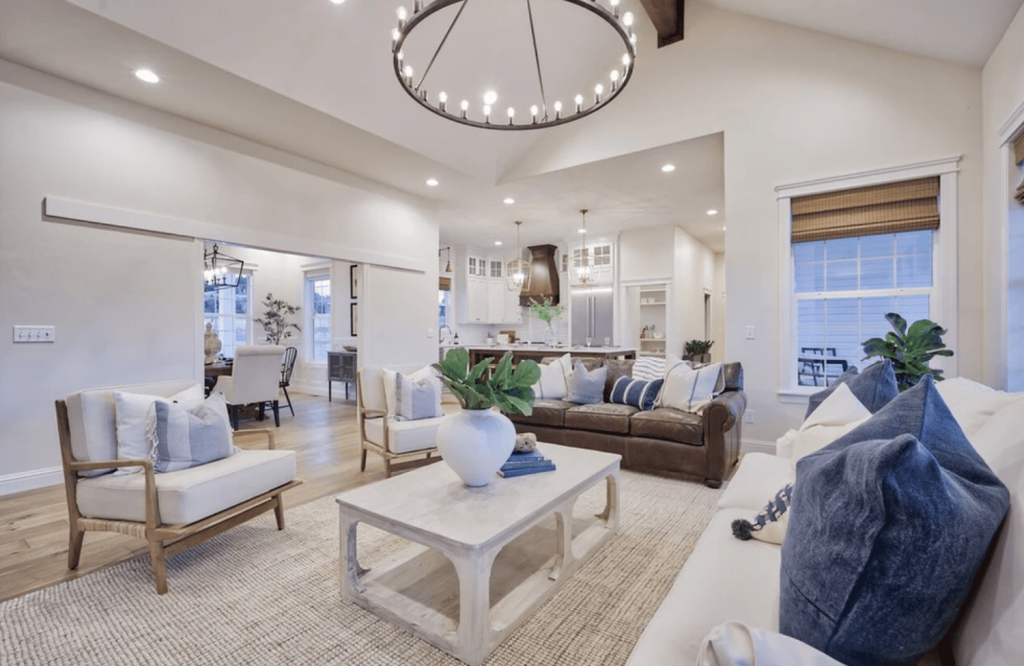
III. Layout Principles: Use light to make a small space appear larger
1. Distance from the wall and spacing
The layout of recessed lights is not necessarily better the denser it is.
A general rule of thumb is:
The light fixture is approximately 0.9 meters (3 feet) from the wall ;
The spacing between light fixtures is approximately equal to half the ceiling height .
For example, if the ceiling is 2.4 meters high, a spacing of about 1.2 meters is most suitable.
Too much light can be glaring and oppressive; too little light can easily create dark corners. Especially in small spaces, “even distribution of light” is more important than “brightness”.
2. Zoned lighting vs. whole-area lighting
Don’t treat a small space’s ceiling like a “starry sky”—rows of downlights are not only wasteful but also disrupt the sense of space.
A better approach is zoned lighting .
Kitchen : Recessed lights serve as the main lighting, while under-cabinet LED strips provide task lighting;
Bedroom : Bedside wall lamps create ambiance, while recessed lights provide soft lighting;
Entryway or hallway : A few narrow-beam recessed lights are sufficient; avoid covering the entire area.
Remember this: “Light should fall where you need it, not everywhere.”
IV. Using recessed lighting to create spatial layers and atmosphere
1. “Three-layer lighting method”
To make a small space more stylish, you can use “three-layer lighting”:
Ambient light : Recessed lights provide basic brightness;
Task lighting : Use accent lighting in the reading area, makeup area, and kitchen countertop;
Ambient lighting : Create soft, layered lighting using adjustable angle or wall washer lights.
This not only makes the space brighter, but also gives it a sense of depth and dimension .
2. Use “wall washing light” to expand the visual space.
“Wall-washing” is a very clever lighting strategy.
When light sweeps across an entire wall, the wall is softly “brightened,” blurring visual boundaries and making the space appear larger.
In small spaces, placing light fixtures slightly away from the walls and choosing wide-angle beams can create an ideal “extended visual” effect.
3. Dimming and Color Temperature Changes
Recessed lights, with adjustable brightness and color temperature , can create a more emotional ambiance in a space.
During the day, use cool white light (around 3000K) to brighten the environment;
switch to warm white light (around 2700K) at night for an instantly soft and relaxing feel.
This not only enhances the overall quality but also prevents small spaces from feeling cold and harsh.
V. Installation and Avoidance Tips
1. Understanding Ceiling Structure
Before installation, be sure to check the interior space of the ceiling. If there is no space for a traditional light fixture, you can choose a canless recessed light fixture , which is flexible in installation and saves space.
Also, pay attention to: whether there is insulation, fire protection requirements, air ducts, or electrical wiring. Avoid accidentally cutting or damaging the structure.
2. Electrical safety and rating
With heat insulation layer → IC-rated lamps must be selected;
In humid spaces (such as bathrooms), choose waterproof lighting fixtures.
3. Marking and Measurement
” Measure twice, cut once ” is a designer’s golden rule.
Precision is especially important in small spaces, because an error of a few centimeters can cause uneven lighting or glare.
4. Common Mistakes
Too close to the wall → the shadow on the wall is obvious;
Too many items → The ceiling looks messy;
Full white light without dimming → makes the space appear stiff and cold.
Conclusion: Light is the invisible magic of space.
Want to make “small space, big effect” a reality? Then let lighting help you achieve it.
The advantage of recessed lighting is that it is almost “invisible,” yet it can change the feel of the entire space .
With proper selection, scientific layout, and layering and dimming design, even a small living room of a dozen square meters can have a spacious, airy, and even slightly sophisticated atmosphere.
Lighting fixtures aren’t the main focus, but they can make your home “just the right amount of bright.”
When recessed lighting is cleverly concealed, it becomes the most elegant element in the space design.
https://www.aconfront.com/the-ultimate-guide-to-mastering-home-lighting-design/